Oct 16, 2025
- Sustainability
- Stories
- Europe and CIS
- India, Middle East and Africa
- Asia and Oceania
- Corporate Social Responsibility (CSR)

Panasonic Group’s “The Land of NOMO” Pavilion at Osaka Expo 2025 was a great success. It brought in 470,000 visitors—far surpassing original projections. When the Expo ended, Panasonic began the next ambitious phase of the project. Since the pavilion was designed as a model for reuse and recycling, the initiatives for dismantling the pavilion and repurposing materials had to start right away.
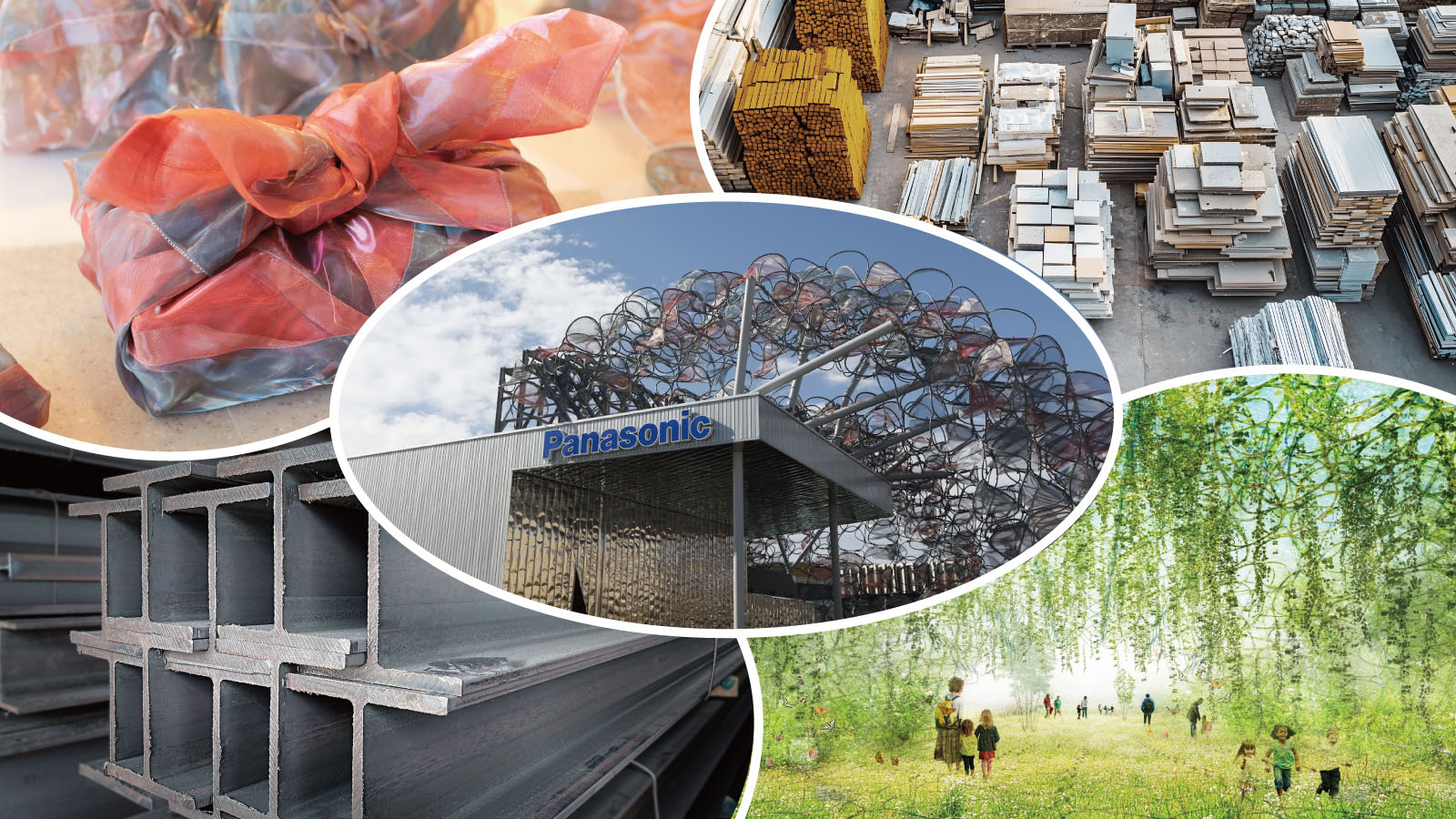
From recycling steel and copper to repurposing facade frames*1 and paving blocks, nearly every component of the pavilion was designed for reuse. Even the symbolic organdy fabric*2 fluttering across its exterior and the staff uniforms will be reused or recycled. As a result, over 99% of the materials*3 used for the pavilion—excluding exhibits—will circulate back into society.
*1. The main steel frames that made up the building’s exterior
*2. A thin, lightweight, membrane-like fabric that is given luster and functionality through metal sputtering
*3. The Panasonic Group Pavilion is expected to achieve a reuse and recycling rate of over 99%, excluding exhibits, calculated by weight of the various building materials (concrete, steel, waste plastic, exterior walls, mixed waste, gypsum board, exterior structures, etc.)
To achieve this high reuse and recycling rate, Panasonic collaborated with many partner companies throughout the entire process—from planning, design, and construction to post-event reuse and recycling. This challenge embodies Panasonic’s commitment to a circular society. This article details some of the approaches used.

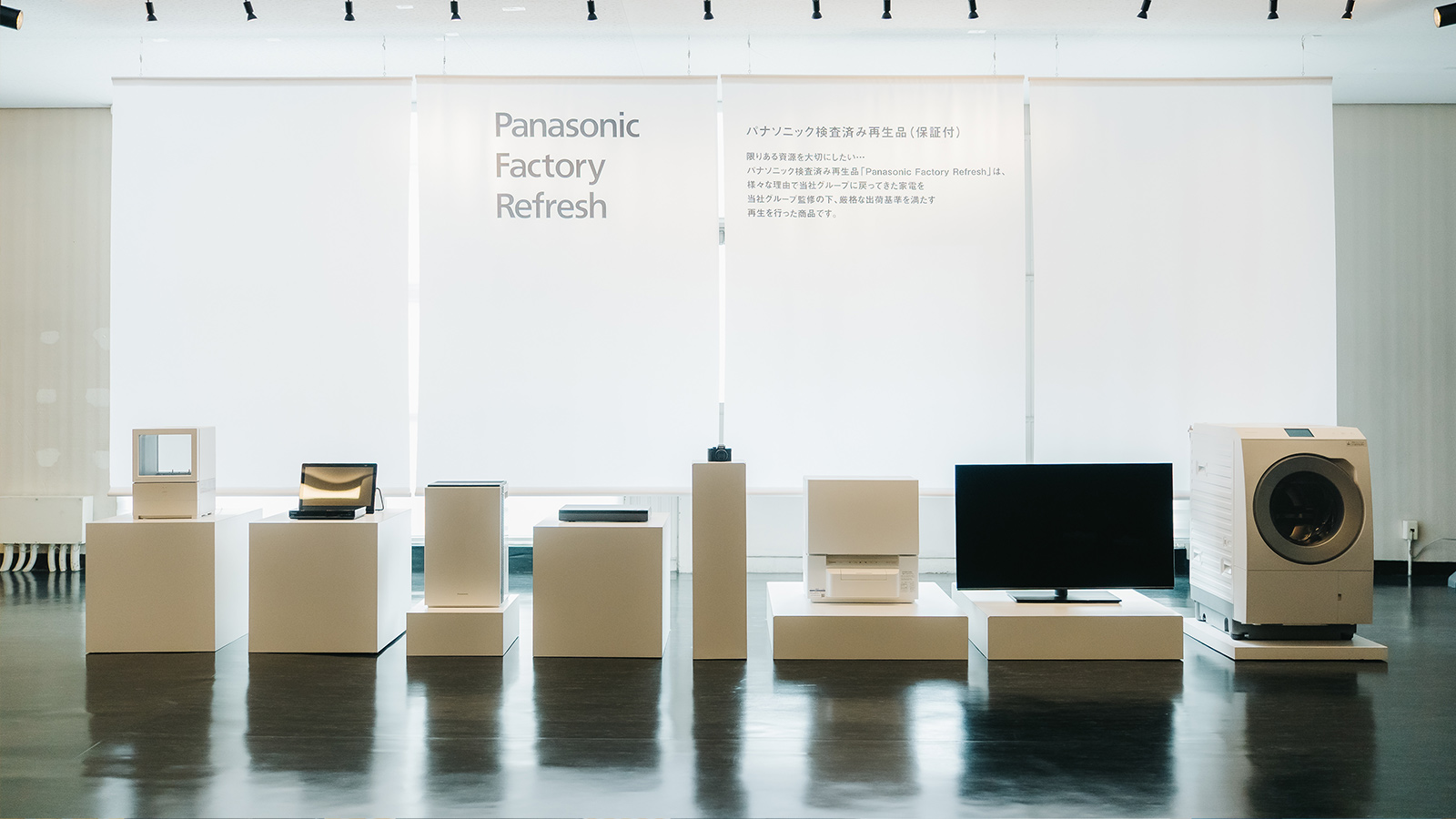
This achievement reflects Panasonic’s long-term environmental vision, “Panasonic GREEN IMPACT” and various efforts to solve environmental problems. For manufacturing, the company has set a global goal of recycling over 99%*4 of its factory waste under the “product-to-product” concept. In Japan, Panasonic already reclaims resin and steel from used home appliances for recycling in new products by Panasonic Group companies.
*4. Factory waste recycling rate = Amount of Materials Recycled / (Amount of Materials Recycled + Amount of Materials Sent to Landfill)
Applying this philosophy to the “The Land of NOMO” pavilion was a natural extension of Panasonic’s circular manufacturing ethos. Adopting a circular ecosystem as the pavilion’s concept, the company aimed from the very beginning to exceed the 98.1% recycling rate target that was originally set by the Japan Association for the 2025 World Exposition.
Recycling rates in architecture depend heavily on material choices. While wood and steel each offer paths to recycle, Panasonic opted for steel frame construction to align with its internal recycling systems. Steel, a high-volume resource in Panasonic’s product ecosystem, was a strategic choice—especially given the company’s established program for reclaiming steel from used appliances.
The biggest challenge was the concrete, which made up approximately 65% of the building’s weight. Panasonic developed a clear pathway for concrete recycling by collaborating with Obayashi Corporation, the pavilion’s construction partner.
“Once we had a solution for the concrete, we saw the potential to reach 99% reuse and recycling,” said Yuichiro Haraguchi, the general producer of the pavilion. “Even lightweight items like floor installations and facade membranes couldn’t be overlooked. By accumulating these minute figures—0.01% at a time—we surpassed the 99% threshold.”
Achieving this unprecedented recycling rate required deep collaboration across the entire supply chain. Panasonic worked closely with Obayashi Corporation, electrical contractors, and parts suppliers. Engagement with dismantling experts and scrap processors began before construction even began. This proactive approach enabled the creation of tailored recycling frameworks for steel, copper, concrete, and other materials.
Through its partnership with Tokyo Steel Manufacturing Co., Ltd., approximately 97 tons of recycled steel—98% of the material used for the pavilion’s main columns and beams—will be returned to Panasonic’s product ecosystem. Similarly, through collaboration with Mitsubishi Materials Corporation, 1.2 tons of recycled copper used in 891 meters of main cables will be reclaimed and recycled in products by Panasonic Group companies.
Additionally, construction materials such as concrete—which constitutes the bulk of a building’s weight—along with gypsum board, plastic, PVC pipes, and metal scraps are also recyclable. Through the power of co-creation, the recycling of architecture has become a reality by applying the concept of circular ecosystem to every single material.
Beyond recycling, Panasonic embraced upcycling—adding new value to materials by utilizing them in their existing form. This approach demands creativity and vision.
Panasonic began with upcycling of scrap and waste materials collected from its factories nationwide in the construction of the pavilion. Those materials were transformed into furniture and lighting fixtures for reception rooms through collaboration with architects. The results of this upcycling will then be reused within the Panasonic Group or relocated to new sites after the Expo.
New value is being created by reusing upcycled materials, and this also extends to education, creative work, and research facilities.
For example, 165 square meters of paving blocks will be reused outside the second phase of “Open Lab 3,” an experimental facility at Obayashi Corporation’s Technology Research Institute in Kiyose, Tokyo. Those paving blocks were part of a total of 749 square meters of paving blocks used outside the pavilion, which were the world’s first ever paving blocks made from glass recycled from the equivalent of about 9,200 used washing machines.*5 Approximately 180 items of 30 different types—including lighting fixtures, speakers, wood decking, and surveillance cameras—will also be reused in “Open Lab 3.”
*5. Out of the 749 square meters of paving blocks, the remaining 584 square meters will be relocated for use in a parking lot at the Panasonic Group’s Kadoma Headquarters.
Rendering of “Phase II,” an experimental building for “Open Lab 3” to be constructed at Obayashi Corporation’s Technology Research Institute, with examples of items that will be reused in the building
The pavilion’s facade frame, along with 40 lighting fixtures and 12 speakers, will be reused in Toho Leo Co., Ltd.’s exhibition area at the International Horticultural Expo that will be held from March to September 2027 in Yokohama. “It’s truly gratifying that the circular ecosystem embodied in the Osaka Expo 2025 Pavilion will be carried forward to another expo,” Haraguchi shared.
Image of the facade frame that will be reused in Toho Leo Co., Ltd.’s exhibition area for International Horticultural Expo 2027
Even the organdy fabric will find new life. Ueda College of Fashion in Osaka, a co-creation partner, will use it as decorative materials for fashion events. Panasonic also collaborated with students from the college during the Osaka Expo 2025 to create furoshiki wrapping cloths and bags from leftover scraps.
Novelty goods made with leftover organdy fabric created in collaboration with students from Ueda College of Fashion in Osaka
Partnerships with educational and research institutions also extend to other areas. For instance, the pavilion’s toilet facilities are being relocated to Kyoto University.
While some exhibits are difficult to preserve in their original form, Panasonic is working in collaboration with relevant organizations to ensure that these exhibit materials are repurposed for future learning and discovery.
Under the “product-to-product” concept, the Panasonic Group is practicing circular manufacturing in every aspect of its business activities. The success of resource circulation at this pavilion are a result of accumulated efforts.
“Of the 470,000 visitors, over 110,000 were children from Generation Alpha,” Haraguchi noted. “Giving the next generation a tangible experience of resource circulation will be our greatest legacy from Osaka Expo 2025. This achievement was only possible through the power of co-creation.”
Haraguchi aspires: “It is our mission as a group to pass on not only new insights on recycling and reuse learned from this Expo, but also the value of co-creation with partner companies as a lesson for the next generation. We’d like to establish this as a new standard for the future that will become deeply rooted in society.”
The content in this website is accurate at the time of publication but may be subject to change without notice.
Please note therefore that these documents may not always contain the most up-to-date information.
Please note that German, Spanish and Chinese versions are machine translations, so the quality and accuracy may vary.