



Aug 31, 2026
- Products & Solutions
- Stories
- Technology
- AI & Robotics
- R&D
- Devices Area
- Solutions Area
- Business Solutions
- Operating Company
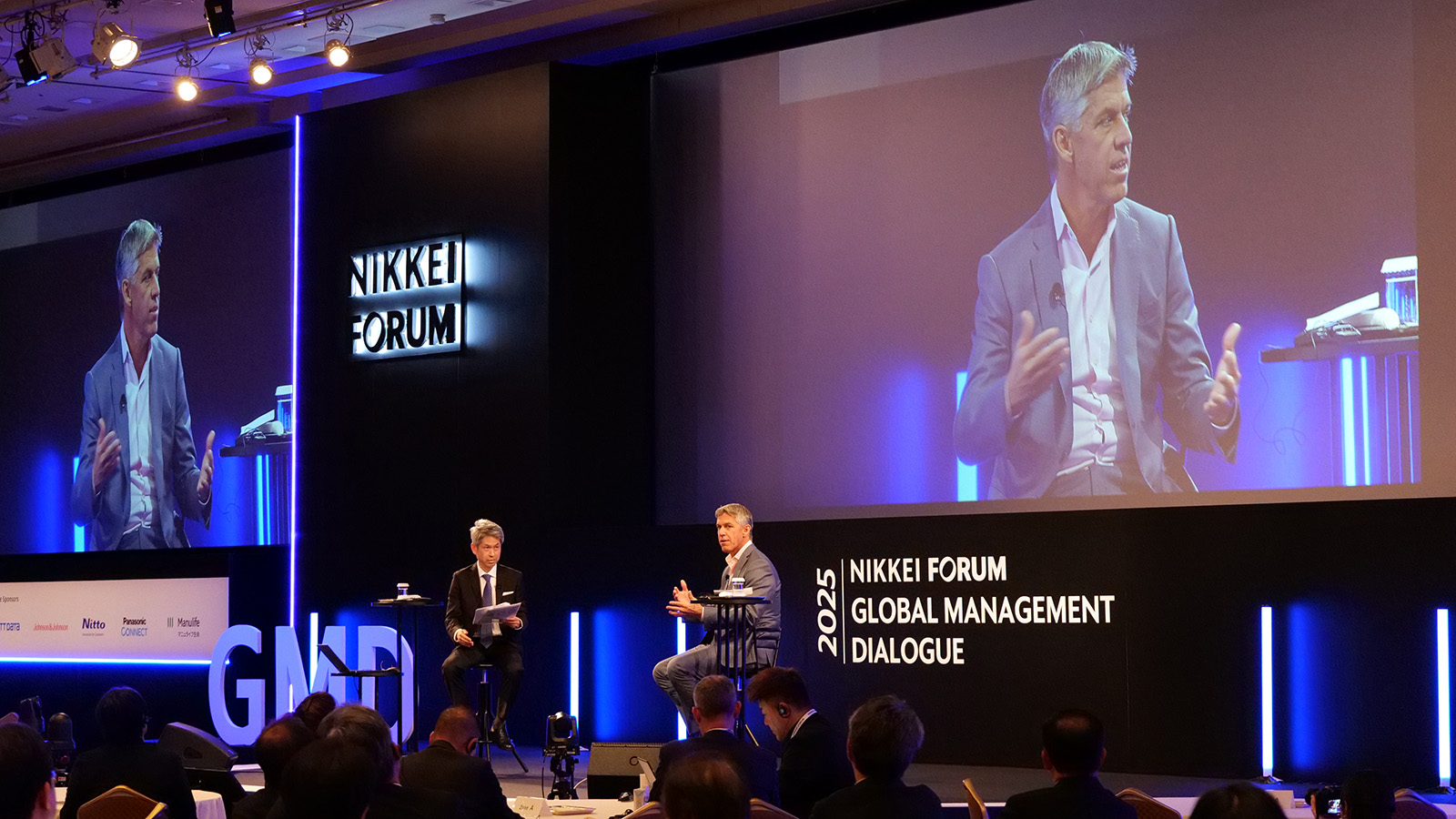
Duncan Angove is the CEO of Blue Yonder, a Panasonic Group company that operates a global supply chain solutions business. His motto is to constantly pursue “curiosity and speed.”
Angove took the stage at the NIKKEI FORUM 27th Global Management Dialogue hosted by Nikkei Inc. on November 5, 2025. He discussed the future that AI is about to bring and the new requirements in supply chain management for the coming era. This article unpacks the supply chain transformation envisioned by Blue Yonder based on his speech and an additional interview that we had with him.
Supply chains are the operating system that moves things around to sustain our world. It encompasses the entire process from forecasting demand for various goods to delivering them to consumers worldwide through warehouses, transport vehicles, and stores.
In recent years, numerous supply shocks—caused by the COVID-19 pandemic, difficulties in using the Panama Canal due to severe drought, rising geopolitical risk from regional instability, and other factors—have occurred in close succession, leaving supply chains facing unprecedented uncertainty.
Changes in long-term trends in consumer behavior, including increases in online shopping and growing demand for personalized products stemming from diversification of lifestyles and values, are also contributing to this uncertainty.
On the supply side, labor shortages are becoming more serious, and problems are compounded by emerging tariff issues.

“All of those things create almost what I would call an age of uncertainty,” says Angove. “So, you need a supply chain that runs with speed and precision—that enables agility to respond to supply shocks or changes in demand.”
Blue Yonder is the AI company for supply chain, serving approximately 3,000 corporate customers across manufacturing, retail, and logistics industries. The company has been innovating in the area of AI utilization since 2003.
The company delivers dramatic improvements in speed and precision for supply chain management. Angove states that achieving this requires connecting various specialized stand-alone software.
“If you look at the history of how supply chains have been run and the software that supported them, it’s generally been very fragmented, and it still operates in silos. Even inside one company—sales, production, logistics, stores, factories—they all operate independently. The issue is magnified when you go outside your organization, across multiple companies in a supply chain. This problem exists across the supply chain, including your carriers, your suppliers, and your customers.”
Blue Yonder announced its new Cognitive Solutions in May 2025 which realize the vision of a common platform for connecting different software.
It is an intelligent system built on cloud-native design and AI data cloud to centralize and optimize decision-making across the entire supply chain, achieving end-to-end interoperability. This reduces the response time from days or weeks to a matter of minutes when disruptions happen. By connecting diverse partners—including manufacturers, wholesalers, retailers, and transporters—on a single real-time platform, the Blue Yonder Network brings together multiple enterprises to eliminate silos and time lags.

At the core of Blue Yonder Cognitive Solutions is the proprietary AI model, SADA Loop, which replicates the human decision-making processes. SADA stands for See, Analyze, Decide, Act. This model enables AI to optimize information visualization, analysis, decisions, and execution in real time, enhancing the precision of responses to supply chain uncertainties. The unique capabilities transform AI from information on a computer screen into actions that create impact in the real world.
For retail, manufacturing, and logistics businesses, supply chains are a major source of corporate value and competitive advantage. Supply chain reform allows for fundamental growth in companies.
“If you were a banker, what you should be looking at are companies whose supply chains run with speed and precision—companies that deliver high growth rates and fundamentally outperform everyone else in their category,” stated Angove, suggesting that the quality of supply chain directly impacts financial performance.
According to Angove, there are two major trends in supply chain reform that companies are undertaking: “The first is building a supply chain business architecture that joins all of the systems within an organization to drive cross-functional collaboration and decision-making internally—and then extending that across the broader value chain of your trading partners, such as carriers and suppliers, and also your customers, so you operate in a more connected way. It is impossible to be fast and precise if you’re not working together in one cohesive team. That’s the first thing.”

Another trend Angove highlights is the utilization of AI. The automotive industry is ahead of the curve with efforts to achieve more accurate decision-making using AI-enabled supply chain software.
In fact, 5 of the top 10 global automotive OEMs are Blue Yonder customers. The company also serves a lot of the leaders in other industries with 23 of the top 25 retailers and 12 of the top 25 manufacturers being Blue Yonder customers.
“This is not starting with supply chain transformation,” responded Angove when he was asked how companies should advance digital transformation in their supply chains. “Instead, you can start very small with solving one particular problem—as long as you have a vision that you want to end up on a common platform.”
Blue Yonder provides a free service to visit customers on-site to conduct assessments of what the issues are and how to begin to change. In many cases, this analysis has found that companies have repeatedly implemented software for specific functions, ending up with a proliferation of applications within the organization that cannot connect or share data with each other.
“Supply chain management is fundamentally a data problem, and a lot of the projects struggle with AI because of data. So you can start small but have the vision to get to a unified platform,” Angove emphasized.
Furthermore, there has been a rapid trend in companies to introduce multiple AI agents to transform operational processes in their supply chains.
Leveraging generative AI’s language comprehension and generation capabilities, AI agents can autonomously handle planning, decision-making, and execution to achieve objectives. Blue Yonder’s Cognitive Solutions also have AI agents that each autonomously manage inventory, shelf space, warehouses, logistics, and networks.

“I think it is a lazy analogy to say that an agent will replace a worker,” Angove offers his personal take on this. He believes that AI agents can instead be used to augment human capabilities, saying “AI agentic technology allows workers to delegate sort of mundane, repetitive, low-value tasks and focus instead on higher-level strategic objectives—collaboration with colleagues and suppliers, things like that. So that actually drives productivity, and hopefully, leads to happier workers.”
Blue Yonder has been a major driving force behind the evolution of the Panasonic Group moving more into recurring business activities, including software and consulting. As the cornerstone of the group’s overall solution strategy, Blue Yonder plays a pivotal role in enhancing competitiveness in the global market.
By combining Blue Yonder’s cutting-edge software and AI technology with Panasonic Group’s long-cultivated sensing technologies, edge devices, which can handle data acquisition, processing, and communication on-site, and manufacturing expertise, Panasonic can create unique, highly competitive solutions. This fusion of digital and physical capabilities represents a unique strength of the Panasonic Group.
In a follow-up interview after the presentation, Angove revealed that multiple projects are already underway. Those projects include using computer vision and AI for yard management solutions that control and optimize the movement of trucks, trailers and containers in the yard of a warehouse. He also shared that the introduction and utilization of Blue Yonder solutions within the supply chains of Panasonic Group’s various business divisions will be further accelerated.

Blue Yonder has invested approximately $2 billion over the past three years in strategic acquisitions and product innovation. In addition to establishing a development partnership with Snowflake, the U.S. technology company that provides a data cloud platform, Blue Yonder has also strengthened its alliance with Microsoft. Plans include joint development of new AI-powered supply chain solutions in collaboration with the Microsoft AI Co-Innovation Labs.
Through these collaborations and partnerships, Blue Yonder’s solutions hold the potential to operate on a more robust data foundation and to evolve into a cross-industry supply chain ecosystem.
Regarding his vision for the future, Angove summarizes, “Our dream is to make the world more abundant and sustainable through next-generation supply chains where humans and AI collaborate. We will keep innovating to realize a future where anyone can leverage the latest AI on the frontlines of supply chains.”
The content in this website is accurate at the time of publication but may be subject to change without notice.
Please note therefore that these documents may not always contain the most up-to-date information.
Please note that German, Spanish and Chinese versions are machine translations, so the quality and accuracy may vary.
Please note that some video content may not be accessible in certain regions due to local restrictions.


