



Aug 31, 2026
- Products & Solutions
- Stories
- Technology
- AI & Robotics
- R&D
- Devices Area
- Solutions Area
- Business Solutions
- Operating Company
To realize a future where people can work in safety, security, and comfort, it is essential to make effective use of CPS (Cyber-Physical System) technology, which collects data by sensors, processes and analyzes the data by AI in cyberspace, and feeds the result back into the physical environment. Let’s take a close look at Panasonic’s Gemba CPS, specifically its potential as a concrete solution to the challenge of creating meaningful time* on the frontlines of client companies.
*As part of its Technology Future Vision setting the direction for R&D, the Technology Sector of Panasonic Holdings Corporation is working to create meaningful time through highly advanced technology. The goal is a society where everyone has the freedom to choose how to use his or her time and live with greater peace of mind.
With advances in IoT and sensing technologies, calls for digital transformation (DX) in manufacturing have been growing since the 2010s. The Cyber-Physical System (CPS) is a core concept of DX. Simply put, CPS is a technological foundation connecting the physical world and cyberspace by utilizing IoT and AI. And today, the fusion of real and digital in manufacturing settings is accelerating.

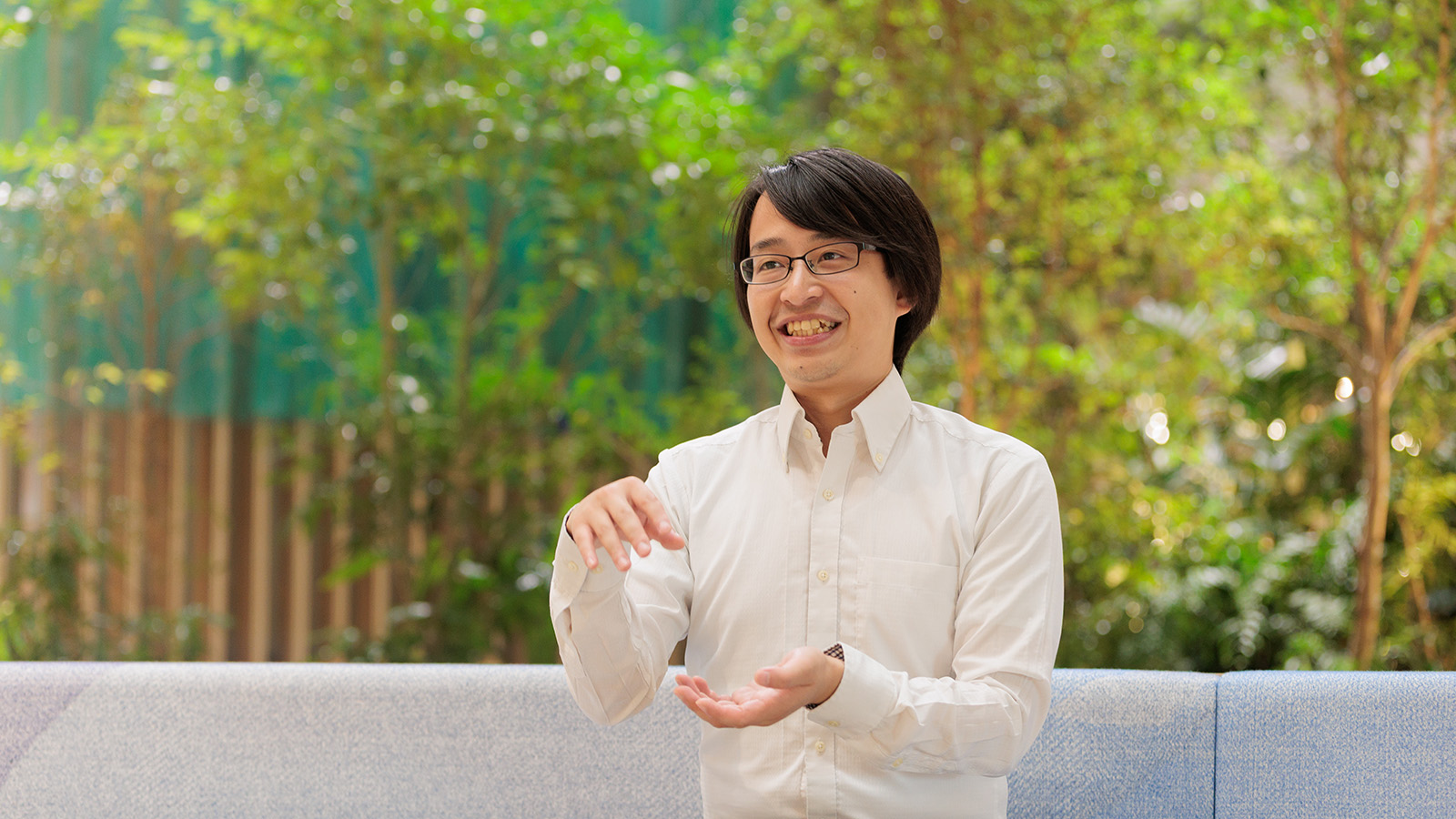
Takumi Tonoike, Digital & AI Technology Center
DX&CPS Division, Technology Sector
Panasonic Holdings Corporation
Meanwhile Panasonic, which has long been dedicated to manufacturing, is going a step further with Gemba CPS. Within the Technology Sector of Panasonic Holdings (Panasonic HD), Gemba CPS is defined as a framework that goes beyond the provision of products to deliver value and solutions to customer challenges. The aim is not only to improve operations, but to transform labor-intensive sites into settings that allow individuals to fully demonstrate their abilities. In doing so, Gemba CPS seeks to enhance efficiency and productivity while promoting Decent Work, work that is fulfilling, humane, and worth doing.
“The distinctive feature of Gemba CPS is its focus on improving operations in the field. Gemba CPS closes the gap between core systems and physical sites, resolving issues that were formerly addressed in isolation by workers, through the use of CPS technology,” said Takumi Tonoike, one of the engineers developing Gemba CPS at the Digital & AI Technology Center. He added that the initiative itself has been under way for some time. The first phase, Gemba CPS 1.0, was completed in 2024.

Gemba CPS 1.0 summary
One of the achievements of Gemba CPS 1.0 was to put in place the elements required to convert tacit knowledge into explicit knowledge. Panasonic HD’s Technology Sector installed Gemba CPS kits with cameras and groups of sensors on production lines. Through high-performance computing (HPC) and edge AI mounted on cameras, site conditions and work performance were visualized in real time, with worker movements labeled and converted to data.
And in 2025, work began on the upgraded version, Gemba CPS 2.0. Tonoike explains the differences between 1.0 and 2.0.
Tonoike: “In Gemba CPS 2.0, field know-how accumulated through Gemba CPS 1.0 is compiled, and optimization algorithms and AI technologies are combined to promote process efficiency and automation. AI is employed extensively throughout the entire process. For example, an AI trained on past cases and outcomes might handle bottleneck detection, a task previously performed by people. When asked questions, such as “Where are the bottlenecks?” or “What are the possibilities for Kaizen?” AI agents trained for each process and specialized site would collaborate to provide optimal answers. Replacing human-led Kaizen with an AI agent model is going to become a driver of ultra-efficiency.”
The flow consisting of sensing site data, optimization in cyberspace, and feeding results back to the site for actuation (control, feedback), is unchanged since Gemba CPS 1.0. But as Tonoike noted, “In Gemba CPS 2.0, the scope of feedback is no longer limited to a single process, but expands to optimization across multiple processes. This is a major turning point in its evolution.” He said that cross-process Kaizen is a pressing need that emerged from listening directly to the field.
Tonoike: “The strength of Gemba CPS 2.0 lies in its feedforward system, the proactive provision of information to improve future actions. Gemba CPS 2.0 is a system that uses AI and diverse data to redesign entire business processes in the field to facilitate smart field operations.

Evolution from 1.0, where Kaizen was left entirely to people, to 2.0, where continuous dialogue with AI agents enables Kaizen in the field, not just in individual instances but with overall optimization.
The smooth progression has been supported by the successful experiences of Gemba CPS 1.0. To date, 1.0 has been deployed at 116 in-house and external sites. At In-house Factory One, work efficiency (units produced per hour) in the assembly process improved by 17%. At In-house Factory Two, the operating rate in the implementation process was boosted by 14%. And at In-house Factory Three, planning time required for sourcing (materials preparation and processing) and assembly processes was reduced by 85%. All of these results are significant.
Tonoike: “Gemba CPS 1.0 has already been implemented, for example at factories producing Let’s note laptops. We’ve also visited various other factories with an eye to introducing Gemba CPS. Among these, the work performed in a refurbishing facility was particularly memorable. Since the facility is a core site handling certified refurbished products, their workflow differs completely from new product manufacturing. Instead of using a production workflow, each item undergoes individual repair, defect identification, and dedicated inspection processes. While I felt confident that the Gemba CPS framework could be applied, it was a major discovery to realize that each site possesses its own unique know-how, its own ‘secret sauce.’”
These close interactions with the field have become an indispensable form of communication for promoting Gemba CPS.
Tonoike: “Data is ultimately just numbers. As such, it is still quite difficult to grasp how the field interprets and makes decisions based on the reality behind the numbers. It is essential for developers to visit sites personally, understand the methods used in Kaizen activities by those directly engaged in them, and connect those learnings to the next stage. Moreover, the data must be presented in a way that AI agents can easily understand. Going forward, we will continue to incorporate new insights in order to pursue Kaizen and optimization.”
As Safe and Secure Operations support to prevent industrial accidents, Gemba CPS was also demonstrated at the Kashima Plant in Ibaraki Prefecture. Tonoike said, “In addition to contributing to labor safety, we want to pursue possibilities in other fields as well.”
He added, “We see 2.0 as a point of departure for broadening and expanding the range of Gemba CPS applications. For example, in the food service and hospitality industries, true value is delivered during time spent on customer service. But in reality, considerable time is required by back-office tasks and staff allocation adjustments, leading to calls for greater efficiency. By applying Gemba CPS here, just as in manufacturing optimization, we can achieve streamlined operations and proper staffing. As a result, Gemba CPS makes it possible to deliver core value at each site, that is, maximized customer service.”

Application of Gemba CPS 2.0 is expanding into a wide range of industries, including restaurants, services, and essential work such as nursing care and hospitals. By taking a bird’s-eye view of the worksite and identifying which operations represent bottlenecks, the workforce can be reduced while maintaining service quality, or operational Kaizen implemented to enhance quality. Tonoike stated that Panasonic HD plans to approach new customer segments accordingly.
Tonoike: “Even outside the manufacturing sector, the Panasonic Group has numerous business partners. We have started collaborating with the Sales Division to build new customer touchpoints through our existing network. For that reason, we believe it is important that interviews like this serve as an opportunity for people in various fields, who are facing challenges, to become aware of and understand the benefits of Gemba CPS. We are still refining it, but development teams are already coming to recognize the value brought by the fact that data analysis, which previously had to be performed manually, can now be automated.”
Gemba CPS 2.0 is expected to go into full operation sometime in FY2027* or later. Between FY2026 and FY2027, proof-of-concept deployment will be carried out at a single site, followed by expansion to around 10 sites. Development team headcount already numbers in the dozens, reflecting the magnitude of Panasonic HD’s expectations for Gemba CPS 2.0.
*Fiscal 2027 refers to the period from April 2026 to the end of March 2027.
Panasonic HD’s Technology Sector points to Employee eXperience (EX) enhancement as the key to spreading Gemba CPS, with its core concept of Decent Work, across all kinds of industries.

Less labor, more joy, diverse workstyles. By making this vision real, Gemba CPS will create meaningful time.
“You can deliver peak performance.” “You can provide greater value to customers.” “You can adapt workstyles to individual circumstances.” Efficiency supported by technology enhances work quality and enables diverse workstyles. We asked Tonoike to describe the transformation that Gemba CPS will bring about in the not-so-distant future.
Tonoike: “I think the world will become a place where people can work more comfortably. Daily life will be richer in many ways. Tasks that were once burdensome will be easier. People will approach work with more freedom, rather than being controlled by deadlines, and be able to take time off easily if they suddenly feel unwell. Such a world will allow for truly individual ways of working. Ultimately, the ideal would be a society where burden-reducing technologies and systems are embedded seamlessly, without people even being conscious that they’re using them.”

In an essay in The Path (PHP Institute) titled “Ingenuity in Work Styles,” founder Konosuke Matsushita once wrote, “Working an hour longer than others is noble. It is effort. It is diligence. But working an hour less than before while achieving greater results is also noble. Perhaps that is the direction of progress in human work styles.” Gemba CPS aligns perfectly with the founder’s philosophy. Perhaps this 21st-century solution for workplace transformation has been part of Panasonic’s DNA all along.
Launched October 24, 2025 at The Future of Technology Connecting People and the World
The content in this website is accurate at the time of publication but may be subject to change without notice.
Please note therefore that these documents may not always contain the most up-to-date information.
Please note that German, Spanish and Chinese versions are machine translations, so the quality and accuracy may vary.
Please note that some video content may not be accessible in certain regions due to local restrictions.


