


Sep 18, 2026
- Company
- Stories
- Executive Message
- AI & Robotics
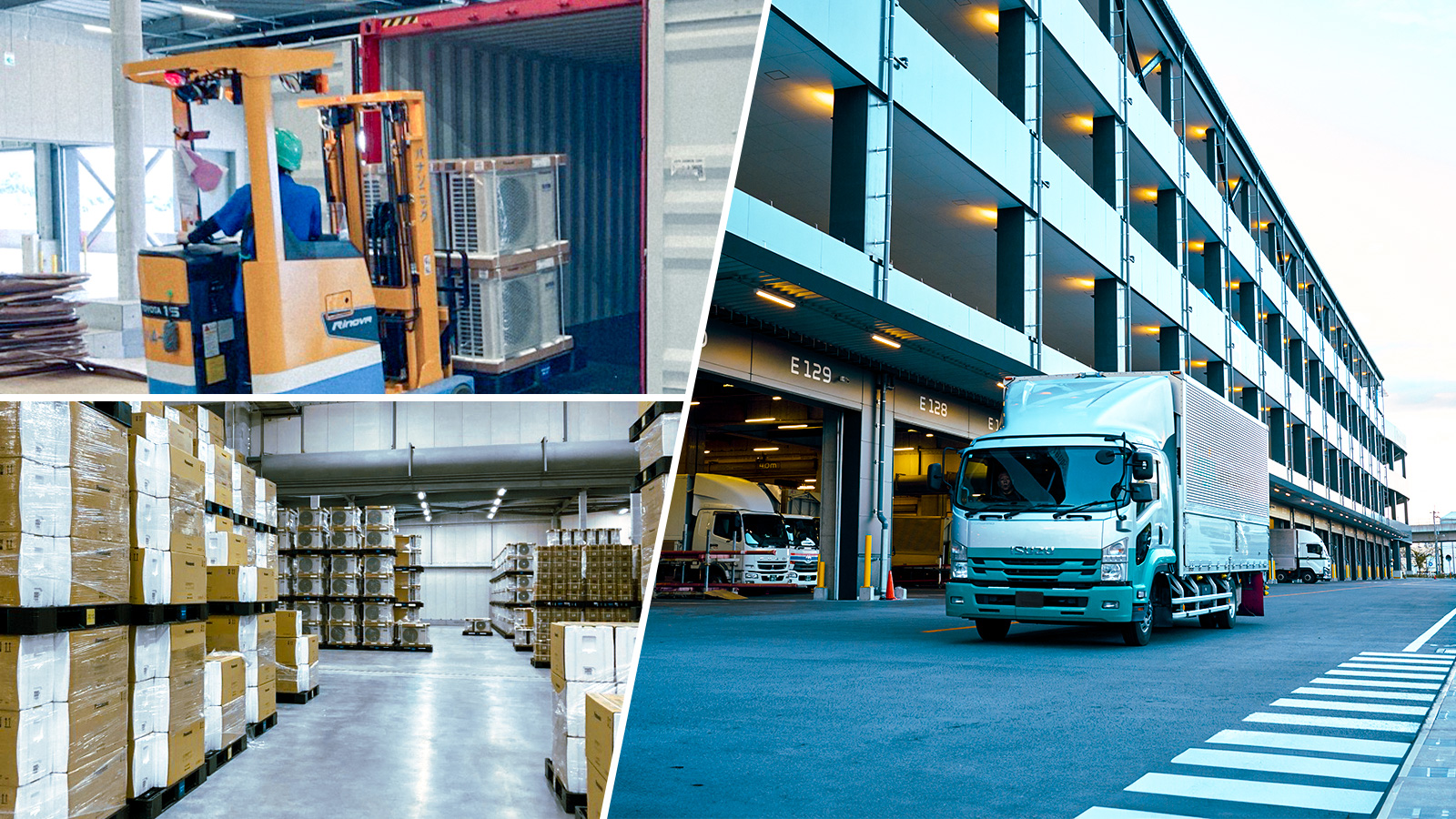
Panasonic Group has established its largest* logistics hub in Kyotanabe City, Kyoto Prefecture, Japan, named “Logistics Operations Center Kansai First.” The hub began operations in August 2025, after consolidating nine logistics warehouses scattered across the Kansai region, western Japan.
*As of September 4, 2025, the new hub has the most floor area of any Group logistics hub. Source: Panasonic in-house research.
Simultaneously, logistics systems have been consolidated throughout the Panasonic Group, integrating previously company-specific operations. That bolsters logistics efficiency and productivity by standardizing warehouse operations, leveraged by digital technologies. At the same time, delivery routes from the hub to customers across Japan have also been optimized. Panasonic Group is accelerating efforts to create faster, more sustainable operational frameworks with operational standardization and digital transformation.
One of Panasonic’s largest logistics hubs
Efficiency improvement
Key initiatives
Panasonic Group launched its Logistics Innovation Project in 2020, establishing a new hub as Japan’s first shared Group warehouse and core logistics hub mainly for west Japan area. The hub is close to the major cities of Kyoto, Nara, and Osaka. The location is ideal for logistics, thanks to its well-connected access to multiple expressways, which fits the aim of the project to optimize logistics by consolidating dispersed warehouses across the Kansai region in an ideal environment for wide-area distribution.

The new hub offers easy access to multiple expressways, providing an ideal environment for wide-area distribution
Kentaro Ando, Executive Officer of Panasonic Operational Excellence (PEX) company, in charge of Group-wide logistics, led the project. “The goal of this project is to build the Panasonic Group’s first-ever integrated logistics infrastructure and standardized logistics operations,” Ando says. “Panasonic Group Logistics Division formulated a clear policy of achieving efficiency through group infrastructure integration, and we began driving reforms in line with that policy, even before labor shortages emerged in the logistics industry as a result of the COVID-19 pandemic.”
Logistics is the final step in manufacturing. It functions as a vital, trust-building point of contact as products are reliably delivered to customers. Reforming the delivery operations could not be accomplished by the PEX Logistics Division alone, as a wide variety of parties are involved in the frontline, where products are delivered to customers. It was achieved with understanding and collaboration on the part of everyone involved, from customers and factories to sales divisions of Group companies and partnering enterprises.
At the launch of the new hub, three initiatives kicked off simultaneously on the frontline: relocation of stored products, optimization of transport and delivery routes, and office design review. Each initiative itself was a project involving members across departments, one that re-examined the functions of the hub in a fundamental way. The reforms were driven by a strong commitment on the part of frontline employees, who believe that logistics is the lifeline of the Group’s business—one that must run smoothly and continuously, around the clock.
Roughly three million items comprising 12,000 types were formerly dispersed over nine locations. These needed to be safely and efficiently relocated to the new hub with no interruptions to customer delivery. While inventory amount was accurately tracked in the existing system, it was impossible to grasp products’ exact size and shape. The relocation planning therefore began by physically confirming what transporting each item would entail, and team members visited each site to verify this firsthand.

Even after grasping an exact overview of all the items, efficiently loading a single truck with a wide variety of products still amounted to solving a three-dimensional puzzle. The main products delivered from this hub are lighting products that belong to Panasonic Corporation’s Electric Works Company. More than 10,000 product types were involved, and because the items varied significantly in shape and size, efficient loading required meticulous innovation. Because some products could not be stacked on pallets, stacking equipment was introduced for better transport efficiency. By accumulating insights on-site, the team was able to determine the optimal loading approach in each case.
To optimize delivery, a major revision of delivery routes and time slots was undertaken. Deliveries that previously had been concentrated in the early morning were reallocated to one of three time slots based on customer needs. To further reduce the burden on drivers, all nighttime unattended deliveries were shifted to mornings. By using digital technology to visualize delivery operations, data such as truck arrival and departure times could be centrally managed. This enhanced visibility and reduced problems significantly. On the first floor of the hub, multiple monitors were installed to constantly display transport status and on-site operations progress.
In addition to reorganizing the hubs, office space design was thoroughly revised. The offices for dispatch operation were formerly in a separate building from other offices, which impeded collaboration. Integrating operations on a single floor afforded an opportunity for space design that would boost employee motivation and facilitate communication. The entrance was fitted out with artificial greenery and indirect lighting fixtures bearing the company name, to provide visual comfort while projecting a strong corporate brand image. Window space was maximized for a well-lit space, and monitors and other equipment were installed to help enhance operational efficiency.
The next Panasonic Group challenge is logistics innovation on a global scale. This means approaching domestic and international manufacturing and logistics in a unified way and strengthening import, export, and international hub coordination to boost efficiency across the global supply chain. The new hub in Kyotanabe City is at the core of this effort and will serve as a model of advanced logistics. A Group-wide global conference was held at the hub in fall 2025 to discuss international logistics standards, positioning the new hub as an even more important center for driving future logistics innovation.
In addition to globalization, another pillar is standardization. For example, even a single product transport pallet can degrade efficiency in sorting and management if it differs in terms of size or material. To address this, the Group is promoting the use of common-standard pallets. With such pallets supplied to every business company, shared use and recycling across hubs becomes a reality. The goal is to create Group-wide logistics standards that begin on the frontline.
The efforts at the new hub have evolved into a successful model for the Group, expanding into cross-border collaboration. The commitment of those involved in delivery is a source of business transformation, builds trust with society, and enhances brand value. This process, which began in Japan’s Kansai region, is developing into a solid foundation for sustainable Panasonic Group growth.

Initiatives pursued by young frontline employees are supporting Group logistics innovation. In this revamped facility, stored products are organized neatly on standardized pallets
The content in this website is accurate at the time of publication but may be subject to change without notice.
Please note therefore that these documents may not always contain the most up-to-date information.
Please note that German, Spanish and Chinese versions are machine translations, so the quality and accuracy may vary.


