



![[Video] Panasonic Stories in 60 Sec: Automating iPS Cell Manufacturing](http://news.panasonic.com/uploads/tmg_block_page/cover_image/18966/60sec-automated-ipsc-establishment-system-en.jpg)


Oct 21, 2026
- Company
- Press Releases
- Technology
- AI & Robotics
- R&D
Oct 17, 2025
Company / Press Releases
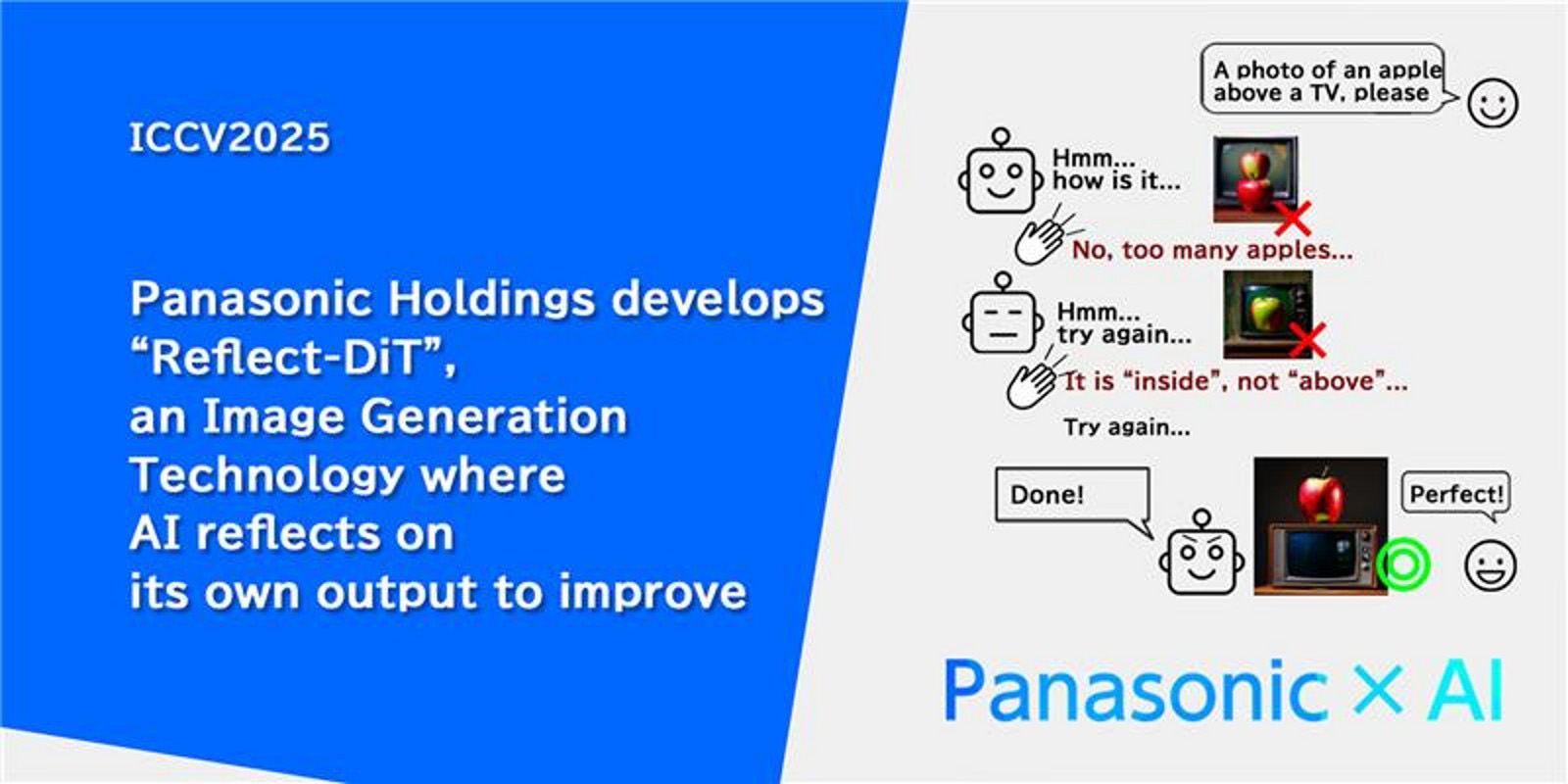
Panasonic R&D Company of America (PRDCA) and Panasonic Holdings Corporation (Panasonic HD) have jointly developed Reflect-Dit, an image generation technology that enables AI to review and improve its own generated results during inference, in collaboration with researchers at UCLA.
In recent years, image generation AI has improved its performance through learning using large-scale data and large-scale models. However, this approach requires enormous computational resources and training time, posing significant development burdens. The newly developed Reflect-Dit employs a novel approach: it directly provides the image generation AI with text-based feedback on areas for improvement in the generated images during inference. This enables the technology to automatically enhance its output without requiring additional training.
This technology has been internationally recognized for its advanced nature and accepted for presentation at IEEE/CVF International Conference on Computer Vision (ICCV) 2025, the premier conference in AI and Computer Vision. We will present at the conference, held in Hawaii, USA, from October 19 to October 13, 2025.
Panasonic HD and PRDCA are conducting research on image generation AI. Recently, in the field of large language models, techniques that perform additional computations during inference to automatically improve generated results have been gaining attention. However, in the field of multimodal models handling both images and language, improvement techniques during inference are still developing. Existing research lacks mechanisms for image generation AI to review its own outputs. Consequently, the mainstream approach involves generating vast quantities of images (sometimes thousands) and selecting the best one from them (Best-of-N), which has posed challenges for improvement efficiency.
Reflect-Dit has developed a technology that directly feeds back improvement points for generated images to image generation AI in text format, aiming to produce high-quality images in shorter timeframes. Specifically, a new network processing the feedback content was added to the input section of the image generation AI. (Figure 1) By having the visual-language model (VLM) compare the generated image with the text prompt, describe areas for improvement in text, and input this into the image generation AI, we have realized an automatic improvement loop where the AI reflects on its own output and applies this to subsequent generations. (Figure 2)

Figure 1 The architecture of Reflect-DiT
Enter the feedback content (a set consisting of the generated image and improvement points) into the feedback processing unit (red frame)

Figure 2 Automatic improvement loop using text feedback
In the evaluation experiment, we compared whether images were correctly generated for various items—such as the specified number of objects (Count), attributes (Attribution), and positions (Position)—using our method and an existing method (Best-of-N) without a feedback processing unit. As shown in Figure 3, we generated 20 images each using our method (SANA-1.0-1.6B+Reflect-DiT) and the existing method (SANA-1.0-1.6B+Best-of-20) and compared their generation quality. The results confirmed that our method demonstrated higher performance across all evaluation metrics. We also evaluated the number of images required to achieve equivalent performance. Our method achieved comparable results with approximately one-fifth the number of generations compared to the existing method, demonstrating its greater efficiency in image improvement.

Figure 3 Evaluation experiment results
Represents the generation quality for the count, attribution, position, and overall total of the specified object. Higher values indicate higher quality.
Reflect-Dit, developed this time, is a technology that automatically improves generated images during inference. For example, applying this method to create catalogs of home layouts and lighting designs for customer proposals in the housing business allows sales representatives to easily edit catalogs on their PCs, promising improved operational efficiency.
Panasonic Holdings will continue to accelerate the social implementation of AI and promote research and development of AI technologies that contribute to enhancing customers' lives and workplaces.
Reflect-DiT: Inference-Time Scaling for Text-to-Image Diffusion Transformers
via In-Context Reflection
This research is a collaborative effort between Konstantinos Kallidromitis of PRDCA, Shufan Li of UCLA, and Yusuke Kato and Kazuki Kozuka of Panasonic Holdings Corporation.
arXiv link https://arxiv.org/pdf/2503.12271
Additionally, the collaborative research between Panasonic HD and Stanford University, “UniEgoMotion: A Unified Model for Egocentric Motion Reconstruction, Forecasting, and Generation” was also accepted for ICCV 2025.
For more details, please refer to the press release below.
[Press Release]Panasonic HD develops “UniEgoMotion” which enables 3D motion prediction and forecasting from egocentric video and head trajectory (Oct 17, 2025)
https://news.panasonic.com/global/press/en251017-4
Also, the following research paper from Panasonic Connect was accepted for the ICCV 2025 LIMIT Workshop (Representation Learning with Very Limited Resources: When Data, Modalities, Labels, and Computing Resources are Scarce).
Intraclass Compactness: A Metric for Evaluating Models Pre-Trained on Various Synthetic Data
Tomoki Suzuki, Kazuki Maeno, Yasunori Ishii, Takayoshi Yamashita
https://openreview.net/pdf?id=G2WCuOVVti
Panasonic × AI website
https://tech-ai.panasonic.com/en/
The content in this website is accurate at the time of publication but may be subject to change without notice.
Please note therefore that these documents may not always contain the most up-to-date information.
Please note that German, Spanish and Chinese versions are machine translations, so the quality and accuracy may vary.
Please note that some video content may not be accessible in certain regions due to local restrictions.